Bill S-211 · Fighting Against Forced and Child Labour in Supply Chains Act
Every year, a report withyour name on it. Signed.Public. Permanent.
Bill S-211 asks you to map your supply chain, examine it for forced and child labour risk, and file an annual report your leadership signs in public. We build the mapping, the evidence, and the due diligence underneath that signature, so it holds.
30 yrs
Doing this by hand
44,000+
Organizations assessed
500,000+
Assessments completed
100%
C-TPAT · PIP · AEO success
Would you sign your name, in public, to a claim about suppliers you have never actually examined?
That is what the annual report asks of your leadership. And the mapping underneath it is the part nobody has the people for.
What Bill S-211 asks of you
The report is one page. The proof is the year behind it.
Flip each obligation. Tick what your team could defend today if the report were challenged. Watch your exposure.
Your live exposure
15
of 15 checks still unmet
Map the supply chain
Do you know every entity in your chain, past the first tier?
flip
Step 01 · Required
Forced labour risk does not live in your direct suppliers. It lives upstream, in the entities you have never listed. The mapping is the foundation everything else stands on. [MANDY-FACT NEEDED: how deep the Act expects the mapping to reach, in her words.]
Assess the risk
Have you examined each part of the chain for forced and child labour risk?
flip
Step 02 · Required
The Act asks whether you looked, honestly, where the risk actually concentrates: by region, by sector, by recruitment practice. A questionnaire nobody verified is not an examination.
Run the due diligence
Can you show the measures, not just describe them?
flip
Step 03 · Required
Policies, supplier requirements, remediation steps: the report describes your measures, and a reader is entitled to ask whether they exist anywhere but the report. Any of C-TPAT, PIP, or AEO satisfies Bill S-211 due diligence, which is exactly the leverage we build on.
Write the annual report
Could you draft this year’s report from records, not recollection?
flip
Step 04 · Required
The report covers what you did this year: the structure, the risk, the measures, the training. [MANDY-FACT NEEDED: filing deadline, who must file, and the attestation requirements, in her words.]
Stand behind the signature
Is your leadership comfortable signing it?
flip
Step 05 · Required
The report is approved and signed by your governing body, and it is public. The signature is the whole point of the Act: accountability with a name on it.
You can complete 0 of 15.
A challenge will find the other 15.
The Act was written for accountability, not convenience. Run your 8 highest-risk suppliers through the assessment and we will surface exactly what the mapping is hiding, in days.
And the report comes due every year.
One supplier nobody examined. One region everyone knows and no one mapped. One journalist, customer, or regulator who reads your public report and asks the question your records cannot answer.
The first report was the easy one. Each year after it, the bar is your own previous filing.
50.5
Median grade / 100. The national median across 92 graded filings. Compliant on paper is the Canadian average. (S-211 Report Card pilot, Jul 2026)
48.9%
Graded D or F. Nearly half of board-signed reports do not demonstrate the diligence the law asks them to describe. (S-211 Report Card pilot, Jul 2026)
29.3%
Skipped the income-loss element. s.11(3)(e) asks what you did for the vulnerable families your enforcement affects. Three in ten filers said nothing at all. (S-211 Report Card pilot, Jul 2026)
2 of 92
Earned an A. Both belong to US multinationals. The A band is open, and it is earned with evidence, not adjectives. (S-211 Report Card pilot, Jul 2026)
A signature is not a formality.
One family. Four ways we carry it.
The program hands you the burden.
We built four products to carry it.
Pick a product to see this page through its lens, or open COMMANDCENTER and watch the whole family answer at once.

The parent platform
A year of proof,
accumulating by itself.
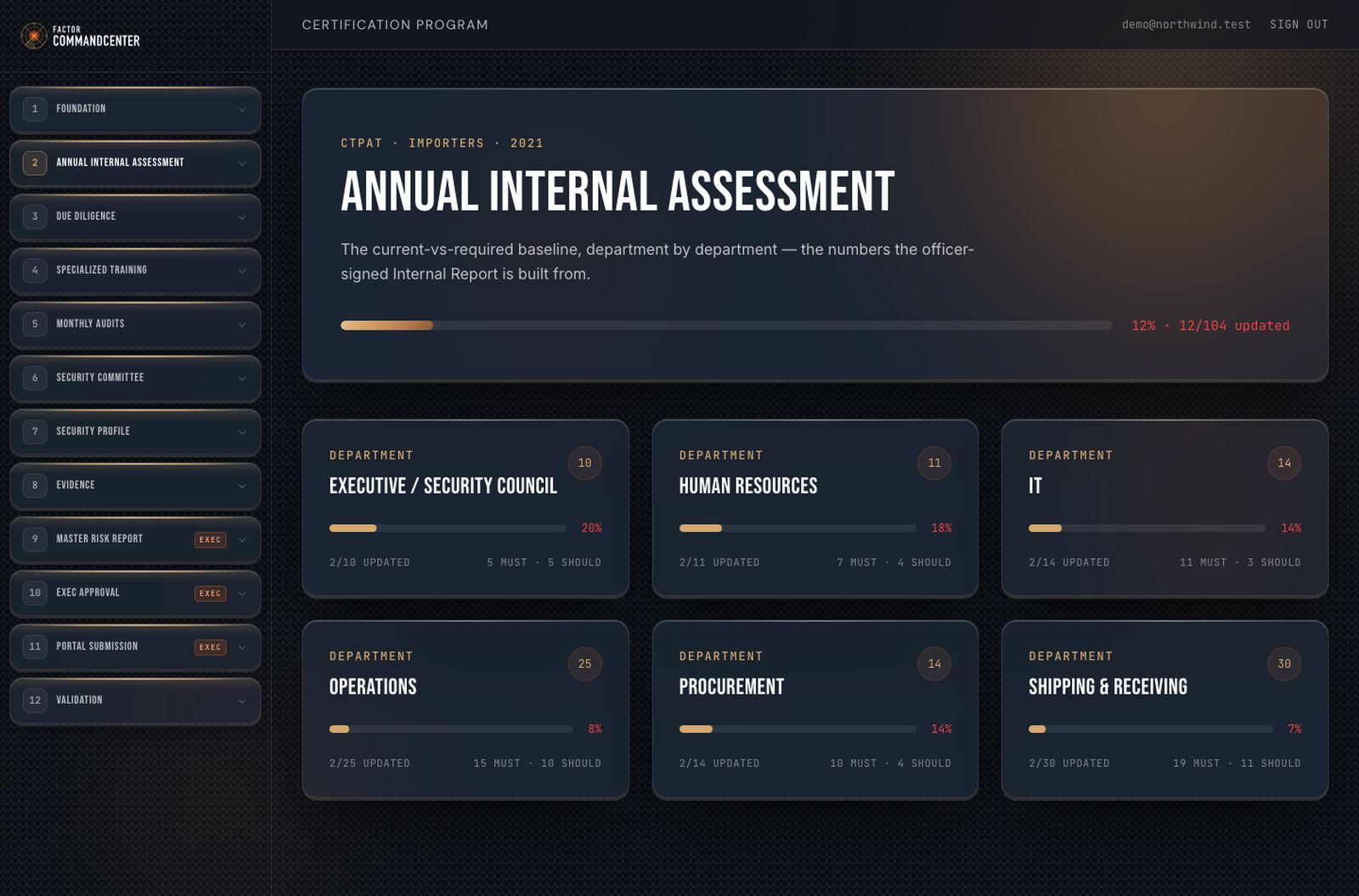
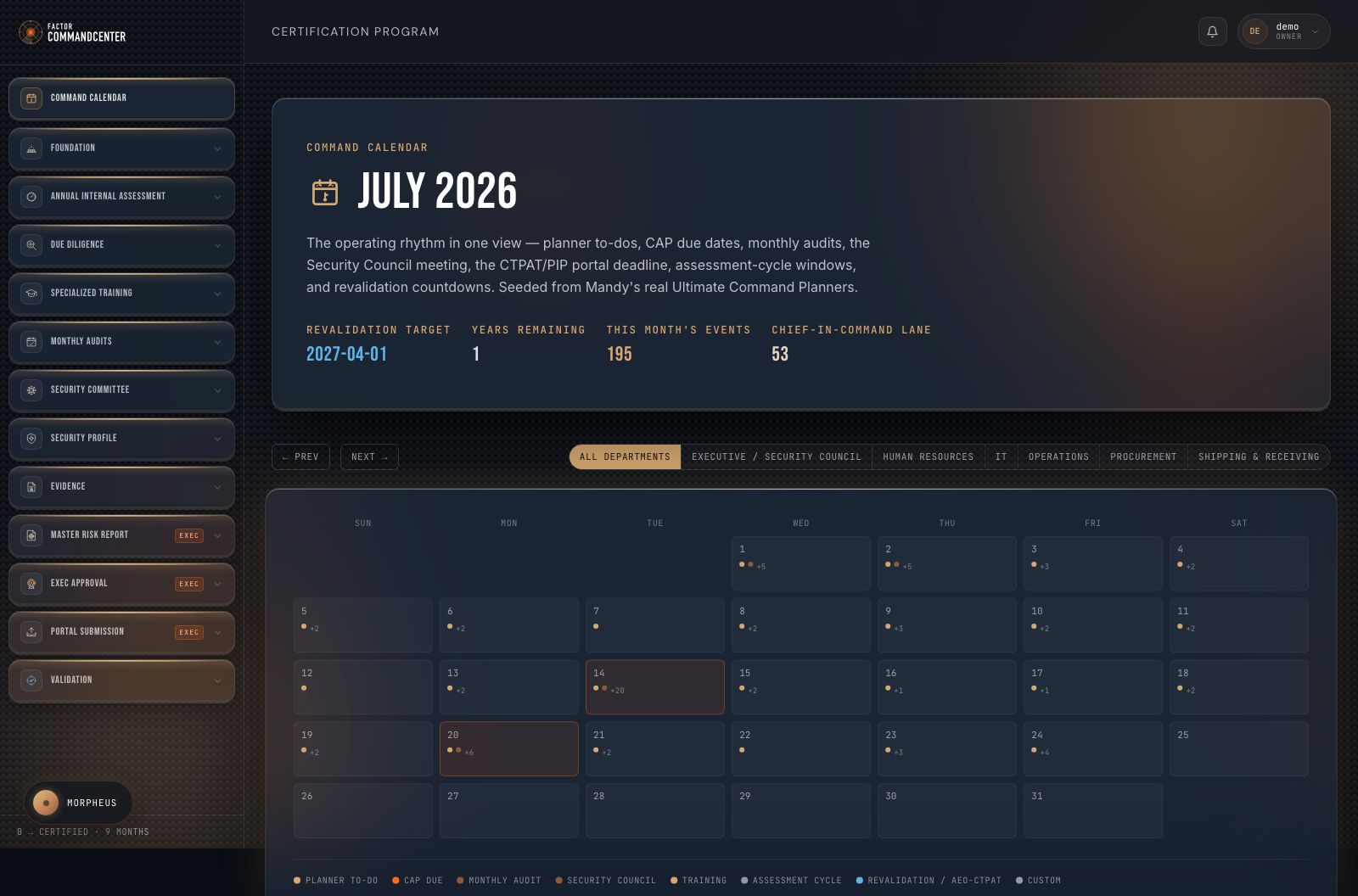
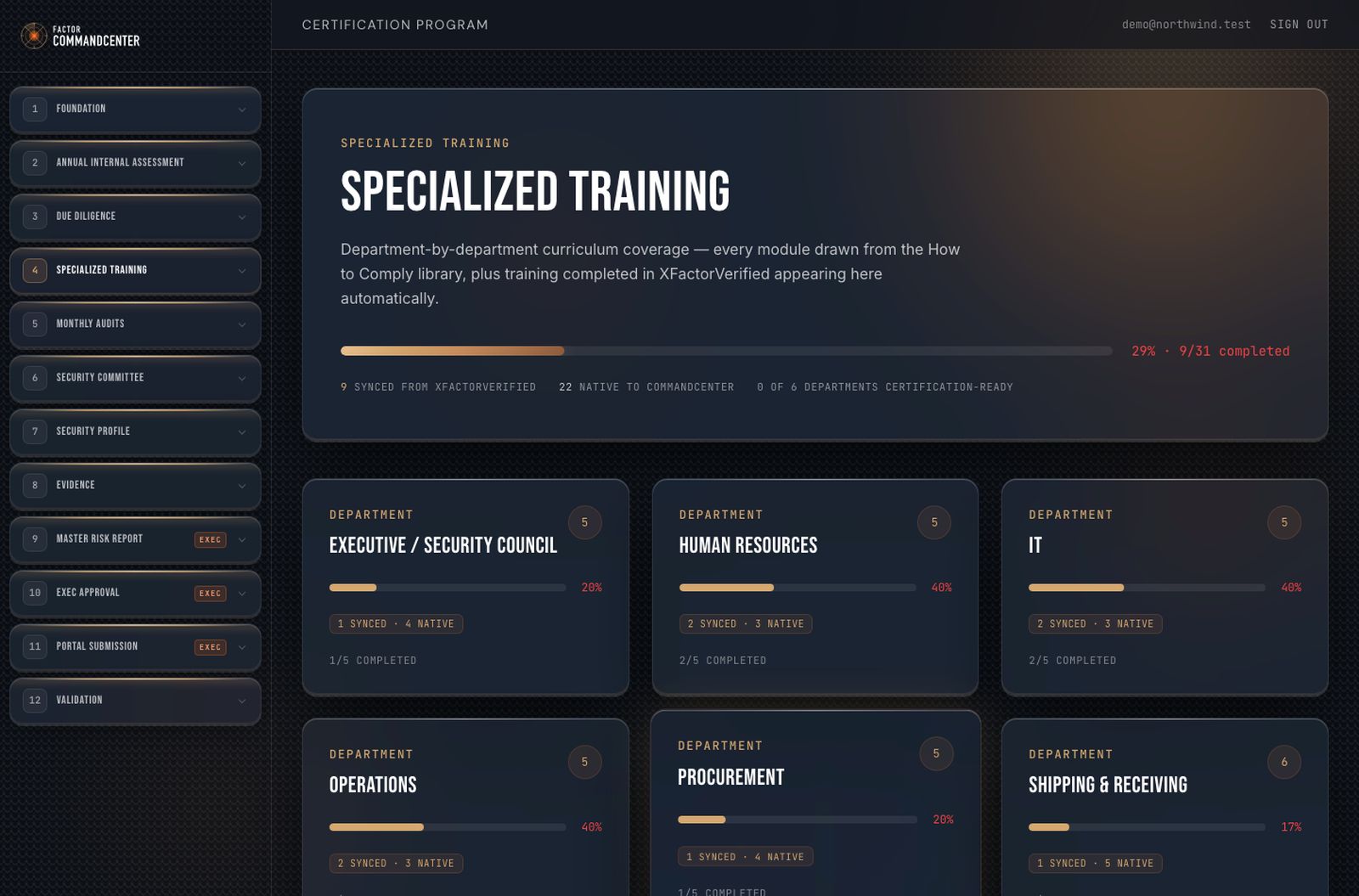
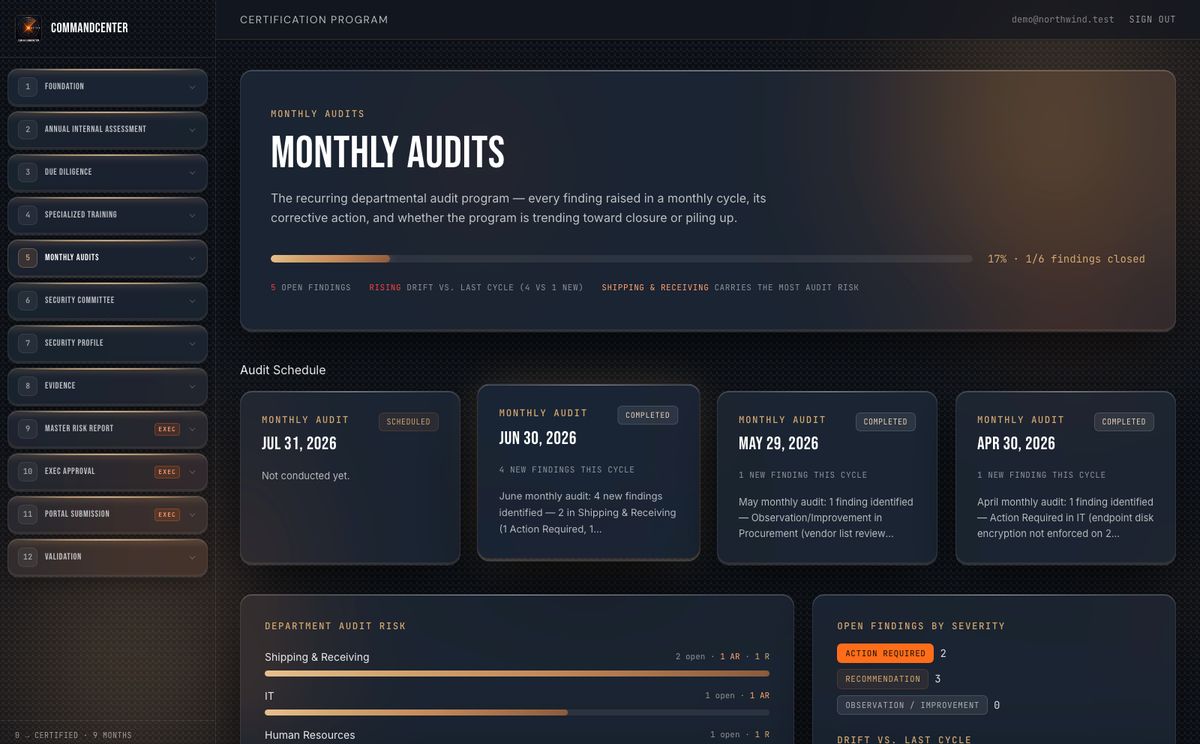
The report covers a year. COMMANDCENTER makes the year self-documenting: department assessments, monthly audits, training records, every obligation on the command calendar. When the filing comes due, the proof is already dated and owned.
- Department bands: HR, Procurement, and Operations each answer for their piece.
- Training records the report can point to.
- The command calendar keeps the annual cycle honest.

Your suppliers, carried
The due diligence,
done and signed.
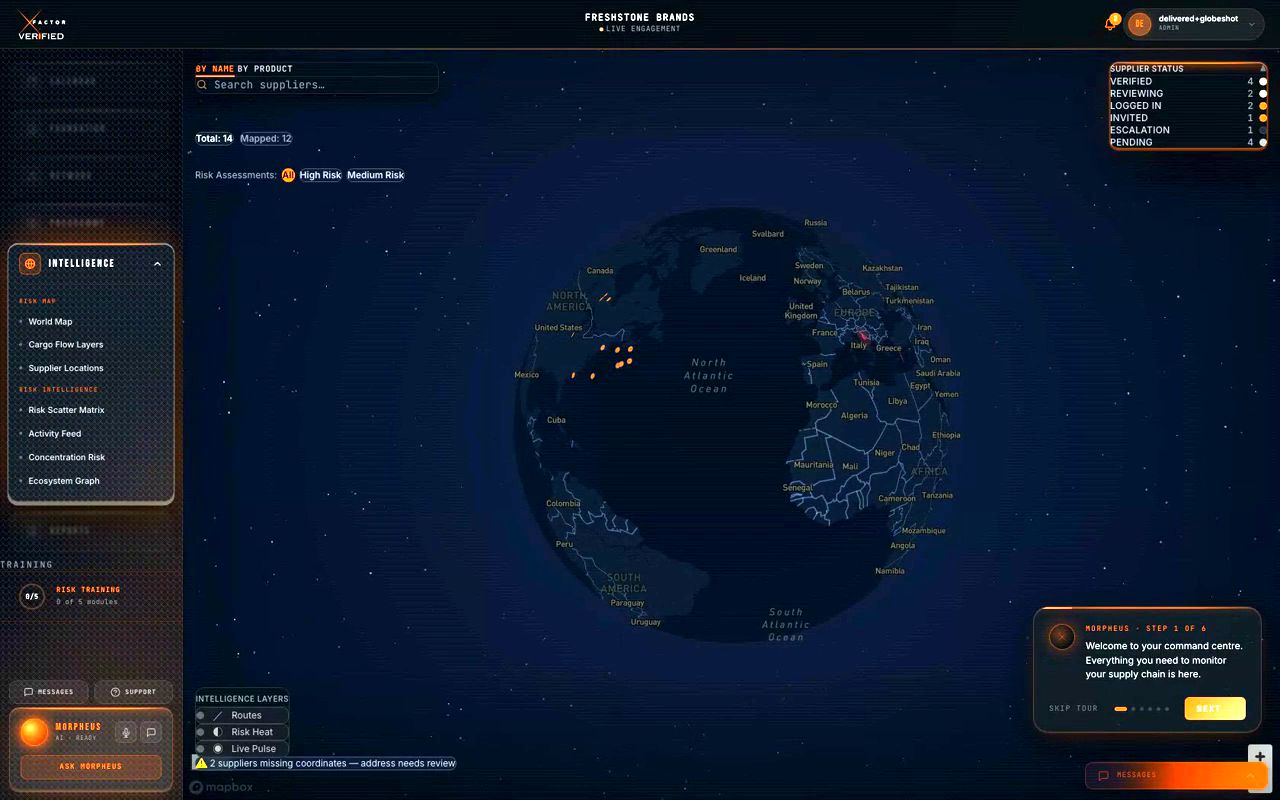
One assessment, mapped to C-TPAT, Bill S-211, PIP, AEO, ESG, and the Nestlé food program. Any of C-TPAT, PIP, or AEO satisfies Bill S-211 due diligence. Your suppliers are actually examined, the gaps actually corrected, and the evidence stands behind the report your leadership signs.
- Drop in your supplier list. Morpheus maps it, past the names you already knew.
- Suppliers reveal the parties you never listed: the map grows to the truth.
- Every gap becomes a finding with an owner, a deadline, and a signature on the fix.
- A dated evidence trail the annual report can cite, line by line.
Your people, ready
If someone asks your people,
the answers should match the report.
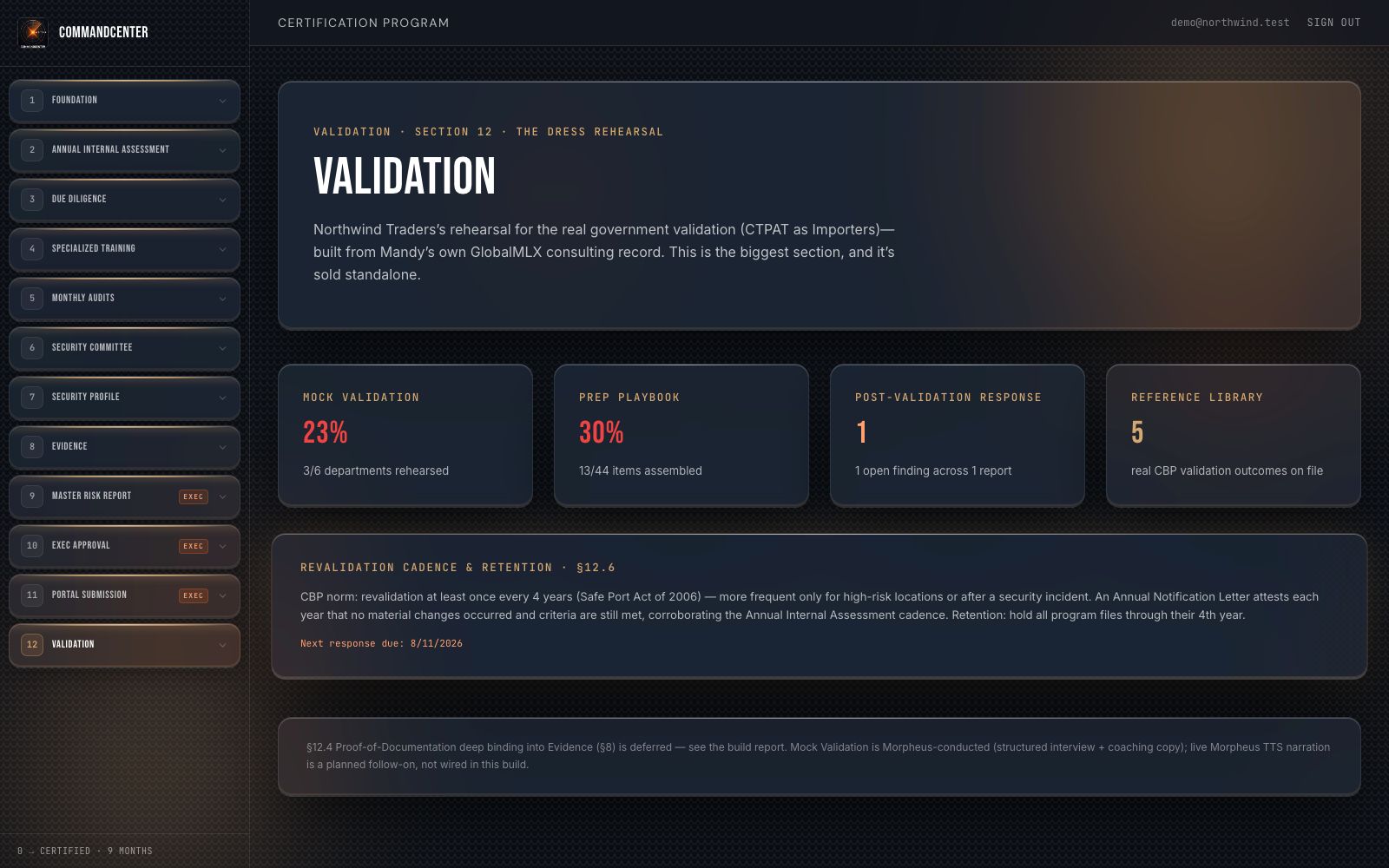
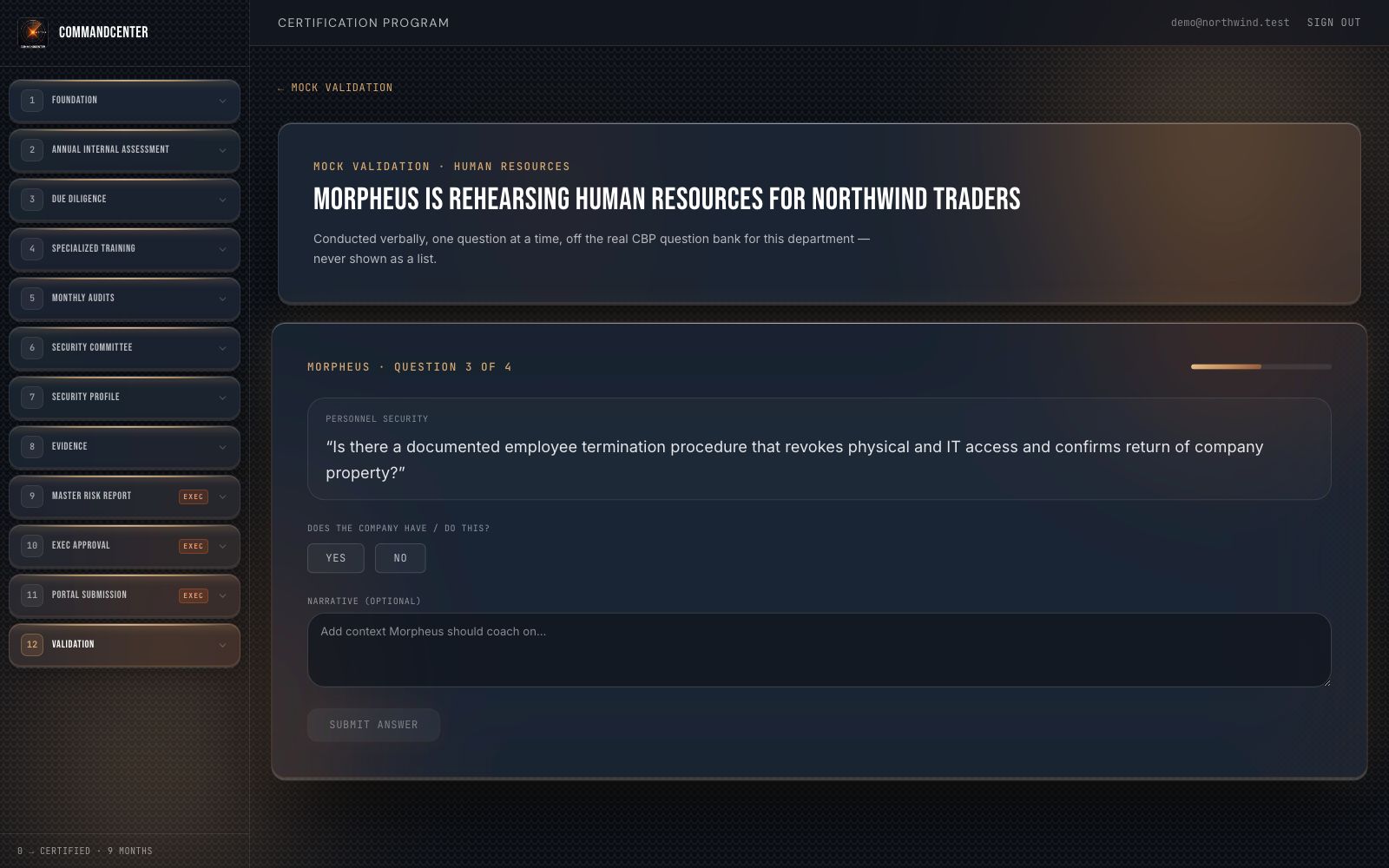
The fastest way a public claim falls apart is an employee answering honestly. VALIDATED interviews your departments the way an outside reviewer would, scores the distance between the floor and the filing, and closes it before anyone else measures it.
- Mock interviews across HR, Procurement, and Operations.
- Every answer scored, every weak spot named before it costs you.
What the burden costs
The reporting year has a cost.
VANTAGE takes it back.
Chasing supplier attestations, rebuilding the map each spring, re-answering what last year already answered: VANTAGE reads the work your departments already log, names the black holes, and returns the hours as recovery you can audit.
- Every finding cites the department’s verbatim answer.
- Recommended, accepted, implemented, verified: a ledger finance can carry.

Bi-weekly supply-chain intelligence
The demands keep moving. The briefing keeps you ahead of them.
On the Hook is the intelligence briefing for the executive on the hook for their supply chain. Regulation reality, enforcement activity, and one move per issue, every two weeks.
Questions you would ask on a sales call
There is no sales call. So here are the answers, straight.
About Bill S-211
Who has to report under Bill S-211?
[MANDY-FACT NEEDED: the entity thresholds and who must file, in her words. Do not publish an AI-drafted answer to this question.]
Does C-TPAT or PIP work count toward S-211?
Yes. Any of C-TPAT, PIP, or AEO satisfies Bill S-211 due diligence. If your chain is already assessed to those standards, the report stands on work you have already done. [MANDY-FACT NEEDED: her preferred wording and any caveats she applies.]
Requesting an assessment
Is it really free? What is the catch?
Yes. Request an assessment of your first 8 highest-risk suppliers. Every request is reviewed personally before access is granted. If we do not surface a gap worth more than the ten minutes it takes to start, you have lost nothing.
Do I have to chase my suppliers to complete the assessment?
No. Morpheus sends each supplier their invitation, follows up on Day 3 and Day 7, and tracks completion in your dashboard in real time. You never send a single email yourself.
8 suppliers · by request
Run your 8 highest-risk suppliers through the full assessment. By request.
- See what the mapping is hiding within your assessment window.
- No sales call. Reviewed personally before access is granted.
- Drag your list in. Morpheus does the mapping. You reformat nothing.
If we don't surface a gap worth more than the ten minutes it takes to start, you've lost nothing.