CTPAT · Importers · U.S. Customs & Border Protection
You hold the certification.
CBP does not evaluate your warehouse in isolation. It evaluates whether you can prove, with documentation, that every partner between the factory floor and the port of entry meets the Minimum Security Criteria, not just the partners you own.
30 yrs
Doing this by hand
44,000+
Organizations assessed
500,000+
Assessments completed
300,000+
People trained
Trusted across three decades of supply chains
Does CBP weigh the same criteria on importers as it does on everyone else in the chain?
Not evenly. The Minimum Security Criteria CBP actually scores you against depend on what you control, and most teams find that out mid-validation, not before.
Who CBP actually certifies here Importers
You hold the certification. Business Partners is where CBP looks first.
CBP certifies active U.S. importers and non-resident Canadian importers, meaning you brought goods into the United States in the past 12 months. You also need an active importer of record number, a valid continuous import bond registered with CBP, and a staffed business office in the United States or Canada. Carriers, customs brokers, Mexican and Canadian manufacturers, third-party logistics providers and other trade entity types each have their own CTPAT membership, with their own eligibility test and their own Minimum Security Criteria guide.
01
Business Partners. You are accountable for your suppliers, carriers, consolidators and brokers meeting the criteria, not just your own four walls.
02
Risk Assessment. A documented, risk-based assessment of your international supply chain, refreshed when the chain changes, not filed once and forgotten.
03
Cybersecurity. The systems that move your trade data, from the purchase order to the entry filing, protected against unauthorized access.
Background screening appropriate to the access each employee has to cargo information and the supply chain itself.
The CTPAT 5-Step Risk Assessment
Here's exactly what CBP requires.
Flip each step. Tick the boxes your team can honestly do today, as an importer. Watch your exposure.
Your live exposure
15
of 15 checks still unmet
Map the cargo journey & every partner
Can you name every party your cargo touches?
flip
Step 01 · Required
This is the step most teams skip. You map the cargo's whole journey, every hand it passes through from the plant floor to the dock. Map only your direct suppliers and the risk hides in the ones you forgot.
Conduct a threat assessment
Have you rated each stop for the threats CBP looks for?
flip
Step 02 · Required
For each stop on that map, you weigh what could go wrong: smuggling, tampering, theft, and the pressures a region puts on its people. Real threats, named honestly, not a checkbox.
Conduct a vulnerability assessment
Can you prove your gaps against all 12 criteria?
flip
Step 03 · Required
Then the harder question: where could someone actually get in? You hold each supplier against all 12 criteria and look for the space between the policy on paper and the practice on the floor.
Write a corrective action plan
An owner, a deadline, and proof of fix for each gap?
flip
Step 04 · Required
Every gap gets a name, an owner, and a date. Not a note in a binder, but a fix someone is accountable for, with proof it actually happened.
Document the process, every year
Could you hand a validator your process tomorrow?
flip
Step 05 · Required
Last, you write down how you did all of it and keep it current, so when a validator asks, you hand them a living process instead of scrambling to rebuild one.
You can complete 0 of 15.
A validator will find the other 15.
These five steps were written for a customs officer, not a procurement team with a day job. Run your 8 highest-risk suppliers and we'll surface every gap they'd find, in days, and hand you the report.
Program guide
Get the CTPAT · Importers program guide
What the program asks of your operation, step by step — the same criteria the live page shows, as a PDF your team can walk through.
The criteria are already running against you.
The five-step risk assessment is written for exactly this seat: map the whole cargo journey, including every partner you do not control directly, rate the threat at each stop, hold each partner against the twelve criteria, write a corrective action plan for every gap, and keep the whole record current for your yearly security profile update and for the revalidation CBP schedules about every four years.
Waiting is the most expensive thing you can do.

The parent platform
CTPAT is not a season.
It lives in your departments.
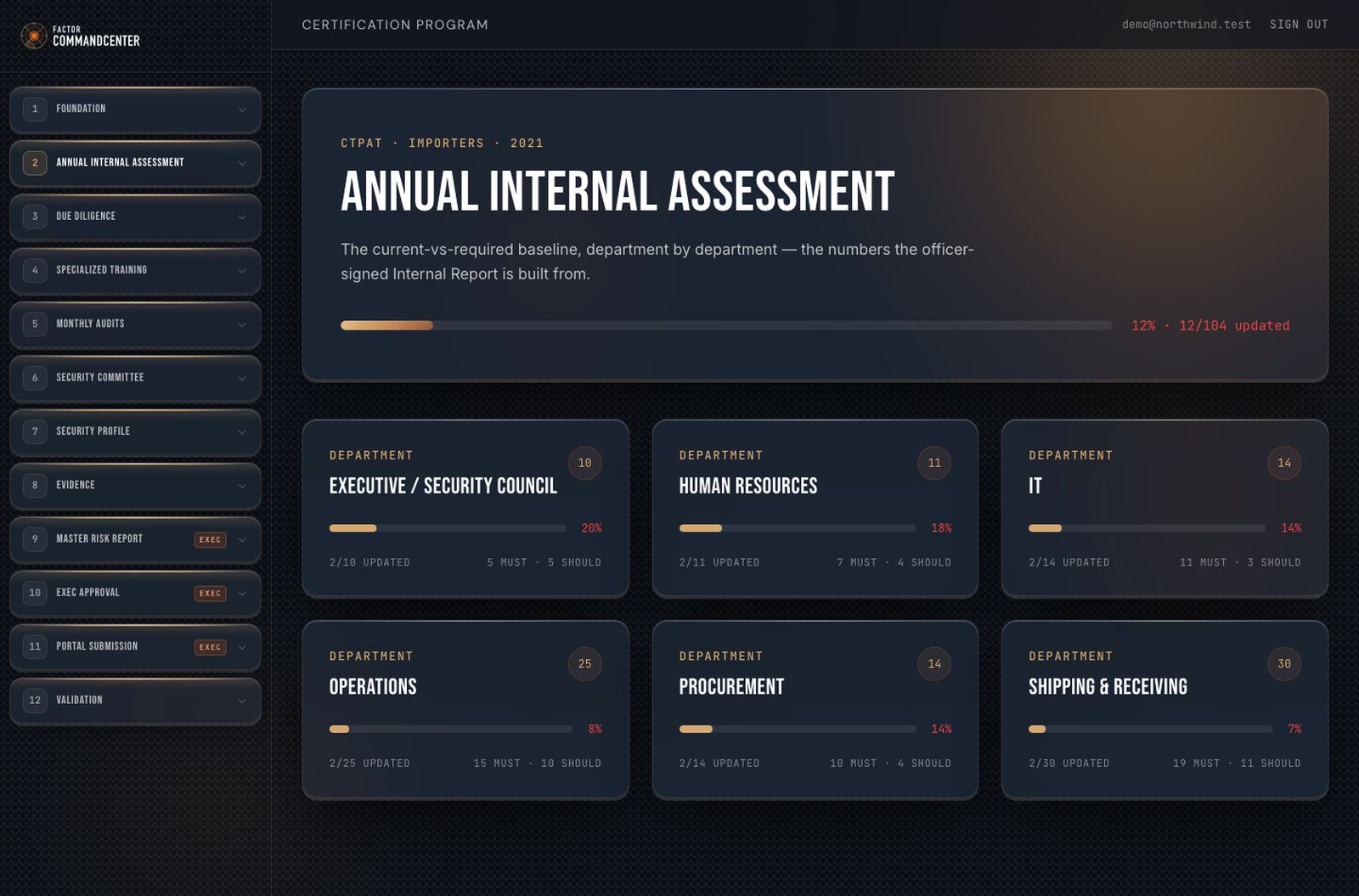
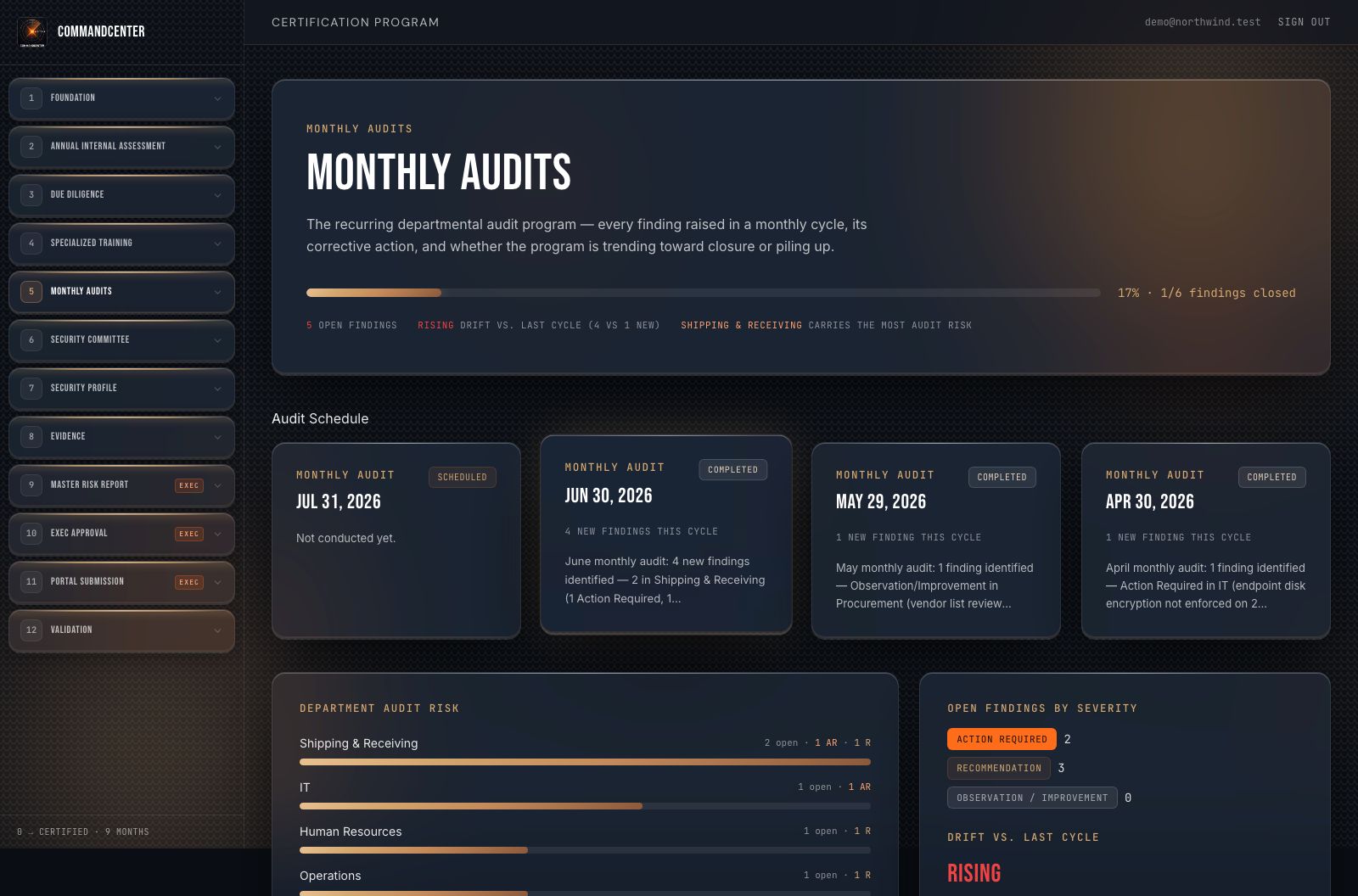
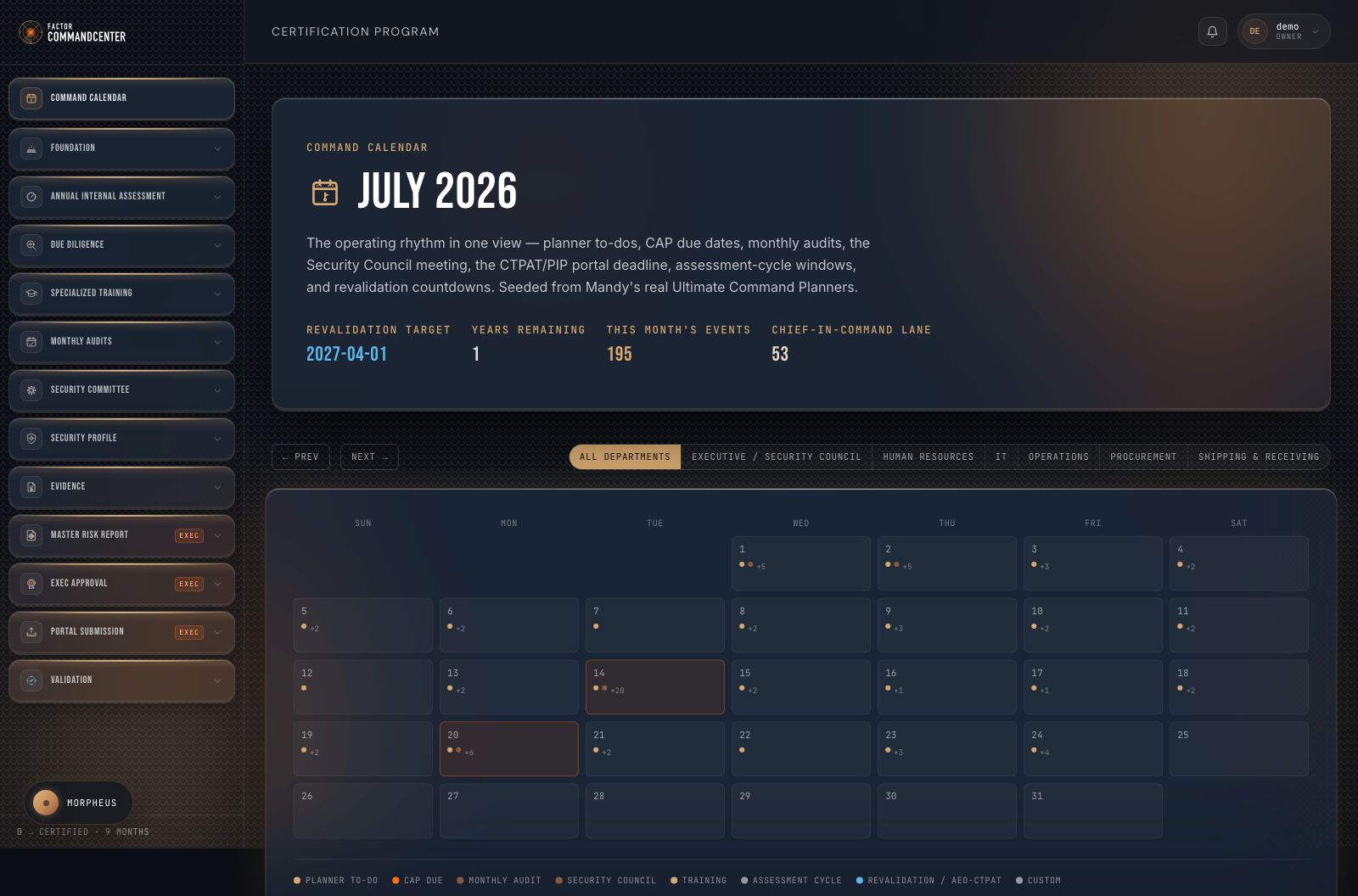
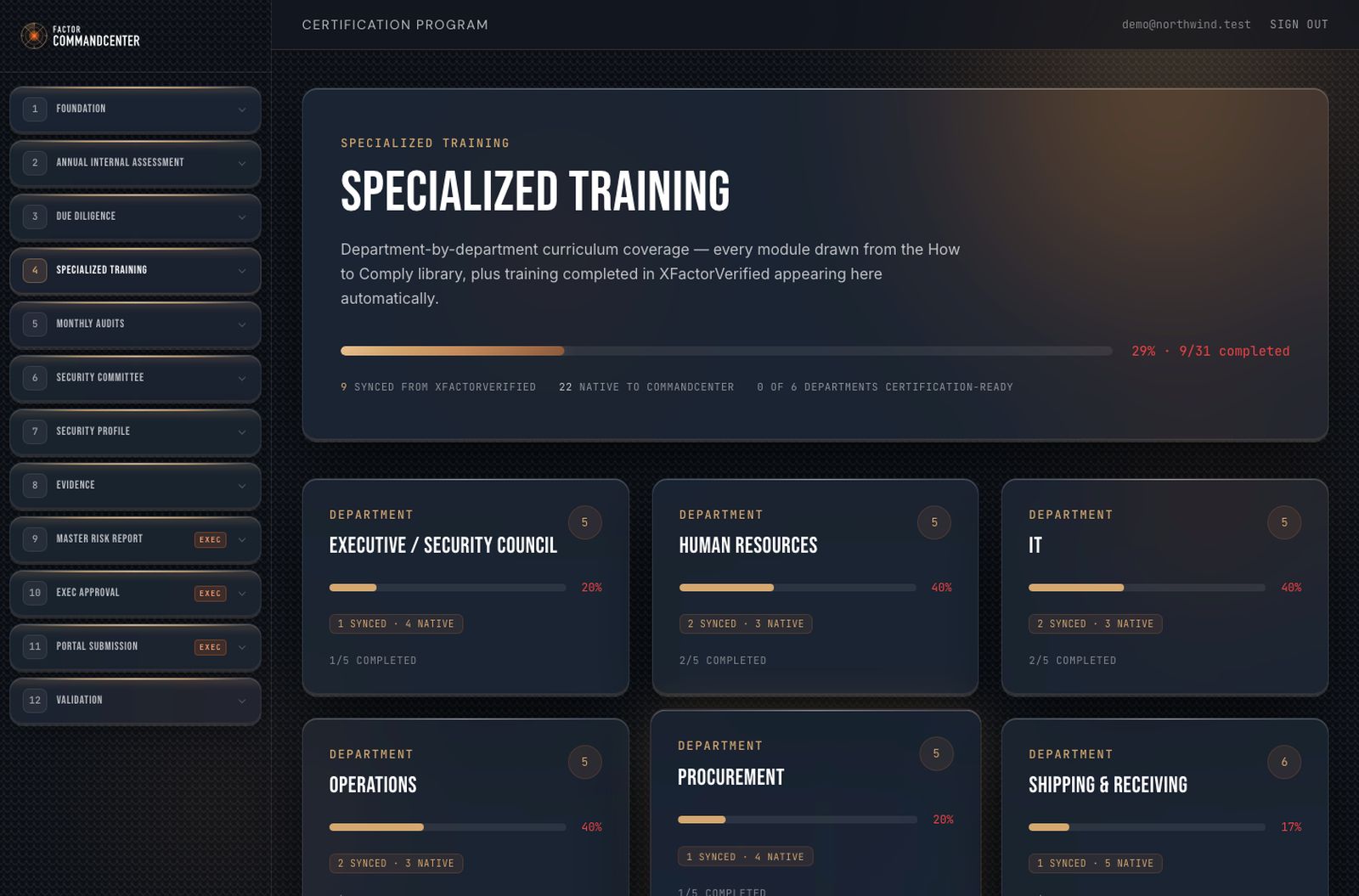
Certification is won or lost between the annual assessments: in HR, in IT, in Shipping & Receiving, on the days nobody is watching. COMMANDCENTER gives every department its own criteria, its own audits, and one command calendar with every obligation on its date. The program stops being a scramble and becomes how the building runs.
- Department assessment bands: each team answers for its own criteria, in its own language.
- Monthly audits catch the drift before a validator does.
- The command calendar: every renewal, review, and follow-up on its date, checked off where everyone sees it.
- Training built in, so the person at the dock knows why the seal matters.

Your suppliers, carried
We run the five steps on every supplier.
You keep the certification.
XFACTOR runs the actual CBP 5-step. It assesses, finds, corrects, and gets your supplier to SIGN. The gap does not get catalogued. It gets closed, and proven closed, before a validator ever asks.
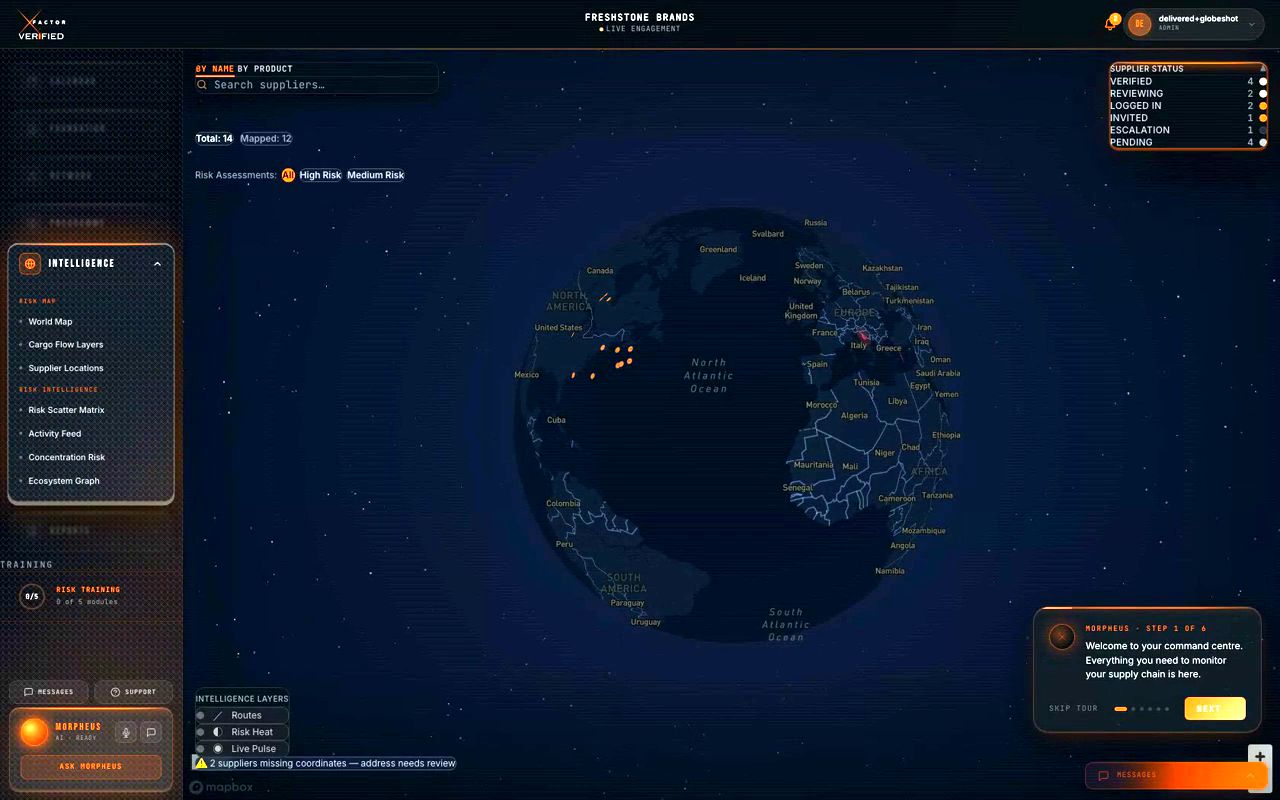
- Drop in your supplier list. Morpheus maps it, no spreadsheet wrangling.
- Each supplier runs the assessment as cinematic scenarios, in their own language, scored against all 12 MSC areas.
- Every gap becomes a finding; every finding a corrective action plan with an owner and a deadline.
- The living Master Risk Assessment Report: the exact evidence package validation asks for.
Bi-weekly supply-chain intelligence
The demands keep moving. The briefing keeps you ahead of them.
On the Hook is the intelligence briefing for the executive on the hook for their supply chain. Regulation reality, enforcement activity, and one move per issue, every two weeks.
Everyone else hands you a map of your gaps. You walk away with every one closed and signed.
The other platforms
- The rating platforms score your supplier and walk away. A medal, not a fix.
- The mapping tools show you where the risk sits. Knowing where the leak is does not stop the water.
- A static PDF, filed once a year, that a validator has already seen a hundred times.
XFACTOR VERIFIED
- You get the real CBP 5-step run on every supplier, the gap corrected, and your supplier's signature on the fix.
- The gap does not get catalogued. It gets closed, and proven closed.
- A living Master Risk Assessment Report, the exact evidence package validation asks for.
Built by the assessor who has run this by hand for 30 years. Not a logo wall.
Not a dashboard. A verdict.
This is what your suppliers walk and what your board sees, every supplier scored, every gap tracked to a signature.
A glimpse, not a blueprint. The full system is what your suppliers walk, not what your competitors copy.
What if one assessment handled all of it, without spending a fortune, without the manual work, and without chasing a single supplier?
From your exposure to verified.
Drop in your supplier list. Morpheus maps it, no spreadsheet wrangling.
STEP 1Each supplier runs the assessment as cinematic scenarios, in their own language, scored against all 12 MSC areas.
STEPS 2 & 3Every gap becomes a finding; every finding a corrective action plan with an owner and a deadline.
STEP 4The whole process documented, refreshed annually, validator-ready.
STEP 5Your supplier earns a verified compliance score and designation. You get the Master Risk Assessment Report.
DONEFound. Corrected. Signed.
Questions you would ask on a sales call
There is no sales call. So here are the answers, straight.
About CTPAT for importers
Who is actually eligible for CTPAT as an importer?
An active U.S. importer, or a non-resident Canadian importer, that has brought goods into the United States in the past 12 months. CBP also asks for an active importer of record number, a valid continuous import bond registered with CBP, a staffed business office in the United States or Canada, a company officer named as your primary cargo security officer, and no outstanding debt to CBP.
Does my own warehouse security get assessed, or only my suppliers?
Both. The twelve Minimum Security Criteria categories apply to your own facilities and personnel, and the Business Partners category holds you accountable for checking that your suppliers, carriers and brokers meet the same bar. A validator asks for evidence of both halves.
What happens if one supplier in my chain will not participate?
When you outsource part of your supply chain, the criteria expect you to do due diligence on that partner, through visits, questionnaires and similar steps, where you have the leverage to ask. A supplier that will not take part leaves a gap you record, weigh as a risk and show how you are managing. The five-step risk assessment records that gap and keeps tracking it.
What changed for importers in 2026?
Two things to know. CBP said it would begin voiding importer of record numbers whose CBP Form 5106 (Importer Identity Form) details are inaccurate or incomplete, starting 18 September 2026, so keep yours current. And under an interim final rule effective 5 January 2027, a foreign importer of record may make informal entries only if it is a CTPAT validated partner or uses a CTPAT validated, licensed customs broker.
Requesting an assessment
What is the catch?
There is none. Request an assessment of your first 8 highest-risk suppliers. Every request is reviewed personally before access is granted. We assess them with the same methodology a CBP validation uses. If we do not surface a gap worth more than the ten minutes it takes to start, you have lost nothing. We run it this way because once you see what the platform finds in your own chain, the conversation about the rest of it is easy.
Why would you give this away?
Because showing beats telling. You watch real gaps surface in 8 suppliers from your own chain. We review every request personally — which is also how we make sure we are showing this to importers who carry the obligation, not to competitors. If what you find is worth more than the ten minutes it takes to start, the decision on the rest is yours. No demo, no pitch, no pressure.
Do I need a credit card to start?
No card, no contract, no commitment. You drag your supplier list in, Morpheus maps it, and the assessments run. The assessment window opens once your request is reviewed and your first supplier receives their invite. If you decide to assess the rest of your chain after the trial, that is when pricing comes in, and it is published on the site. No sales call required.
What does the requested assessment include?
Every supplier in a requested assessment goes through the full intake: email verification, address validation, and watchlist screening against sanctioned and high-risk countries. Then each supplier receives the cinematic scenario assessment, narrated by Morpheus, behaviourally scored. You get findings, gap analysis, and a Corrective Action Plan for every gap found. The only thing gated behind a paid plan is assessing more than 8 suppliers and accessing the full Master Risk Assessment Report for your entire chain.
How long does the 8-supplier trial actually take?
For you, setup is minutes. You upload your supplier list and Morpheus handles the intake: email verification, address check, watchlist screening, and tier assignment. Suppliers typically complete their scenario assessment in 20 to 40 minutes. Most teams see findings well before the assessment window closes. You do not reformat a spreadsheet and you do not chase anything manually.
Do I have to chase my suppliers to complete the assessment?
No. The platform handles outreach automatically. Once you upload your list, Morpheus sends each supplier their assessment invitation, follows up with a Day 3 nudge and a Day 7 nudge if they have not responded, and tracks completion status in your dashboard in real time. You see who has finished, who is in progress, and who has not opened it yet, without sending a single email yourself.
8 suppliers · 14-day trial
Start your 14-day trial: run your 8 highest-risk suppliers through the full CTPAT 5-step risk assessment. No contract, no card.
- See every gap in one assessment window, not the months a consultant takes.
- Reviewed personally before access is granted. The assessment starts when your first supplier gets their invite.
- Drag your list in. Morpheus does the mapping. You reformat nothing.
If we don't surface a gap worth more than the ten minutes it takes to start, you've lost nothing.
30 years · 44,000 organizations · 500,000 assessments · hands-on across CTPAT, PIP and AEO validations.